THE UNITED STATES OF LIBERTY
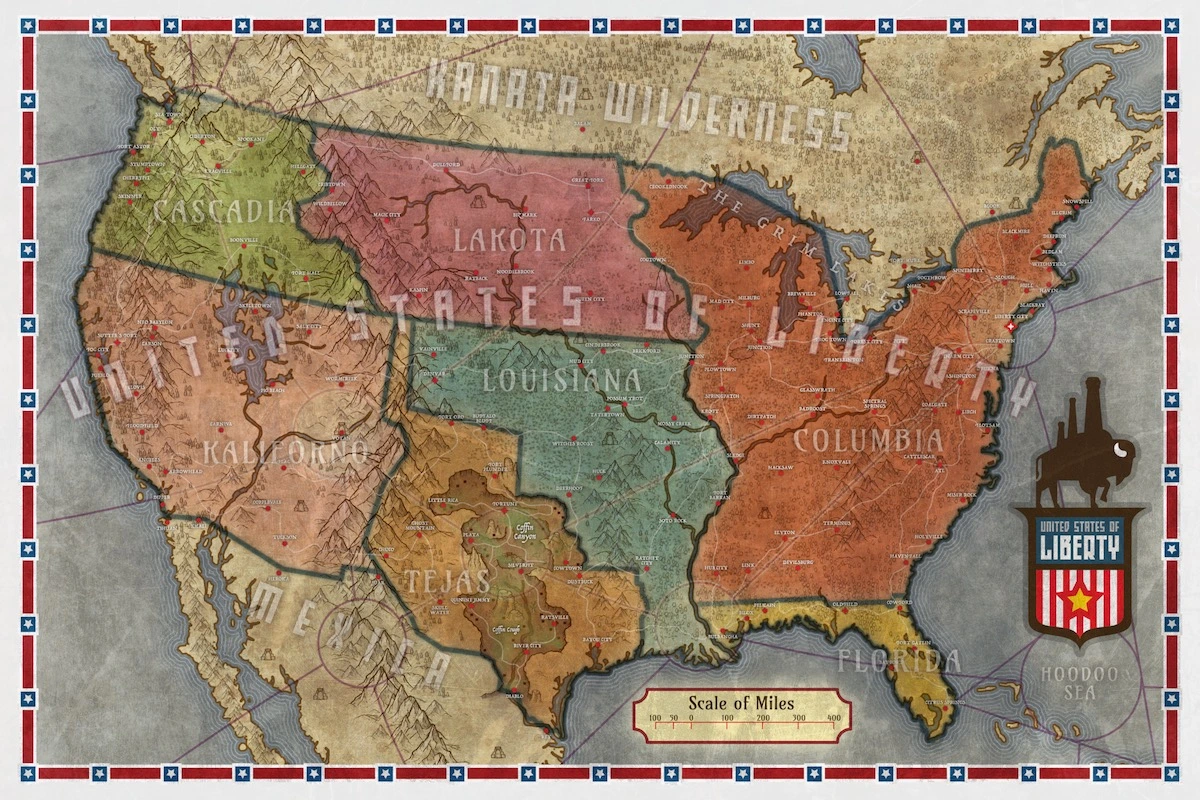
1913 — A Nation on the Boil
The year is 1913.
The United States of Liberty is wealthy, loud, confident, and expanding in every direction at once. It is a nation powered by steam, industry, ambition, and a belief that progress can tame anything—land, people, even monsters.
That belief is beginning to crack.
STEEL, STEAM, AND A FRACTURED NATION
Economically, the United States of Liberty is flourishing. Its fields produce vast quantities of wheat and cotton. Its factories rival the combined industrial output of the Old World powers. Steam engines churn night and day, feeding cities that grow faster than they can be governed.
But this is not a unified machine.
The rail lines that bind the country together are owned by dozens of competing companies, each guarding its routes, tariffs, schedules, and grudges. There is no single line that crosses the nation cleanly. Travel is slow, fragmented, and often dangerous. A journey west may require bribes, transfers, delays, or armed escorts—and sometimes ends abruptly when a company’s track simply stops.
The map promises connection.
The rails deliver inconvenience.
STRANGE HEADLINES, STRANGER TRUTHS
Recent events have unsettled even the most confident citizens:
The Titanic airship vanished in 1912, swallowed whole somewhere over open sky, leaving no wreckage and no answers
Harry Houdini, famed escape artist and illusionist, now serves as the 28th President of the United States of Liberty, a fact that still feels like a trick that hasn’t finished unfolding
Suffragettes march openly in Liberty City and Washington, Columbia, demanding a voice in a nation built on noise
Strange tales leak out of Engine City of men and women displaying strength, speed, and endurance far beyond natural limits
Occult periodicals grow bolder, their discussions of majik slipping from curiosity into public fascination
Official statements insist everything is under control.
Unofficially, control is slipping.
MAJIK, MONSTERS, AND DENIAL
Majik exists. That much can no longer be denied.
What the government denies—publicly—is how old it is, how dangerous it can be, and how deeply it has already taken root in the land. Monsters are treated as isolated incidents. Anomalies. Frontier problems.
They are not.
As industry spreads west, it disturbs things better left buried. Majik leaks into the soil, the air, the water. Old boundaries fail. Creatures once confined to rumor now stalk rail camps, mining towns, and forgotten canyons.
The further west you go, the thinner the rules become.
Law fades. Maps lie.
And the wild pushes back.
COFFIN CANYON AND THE LIBERTY CORPS
Coffin Canyon has become the flashpoint.
Rather than admit failure, the federal government has chosen force. The Liberty Corps—its uniformed enforcers—have been dispatched to seize Coffin Canyon outright. Their goal is unprecedented: to designate it as the first Forbidden National Park.
No civilians.
No settlements.
No access without government sanction.
Officially, this is about safety.
Unofficially, it is about containment, control, and secrecy.
The Corps arrive with rifles, banners, and paperwork. They do not arrive with understanding.
A CIVILIZED EAST, A WILD WEST
The eastern states still believe themselves civilized. They trust schedules, systems, and institutions. Out west, those things break down quickly.
Company towns rise and vanish. Rail camps go silent. Entire stretches of land become known only by reputation—and are avoided by anyone with sense.
Majik does not behave.
Monsters do not follow borders.
And the land remembers every wound cut into it.
The United States of Liberty calls this progress.
The Canyon calls it feeding time.